Scorecard
Who is ahead this month, and what moved their score?
Scorecard (/reports/scorecard). Whole calendar months — pick one with the Month box. There is no date range.
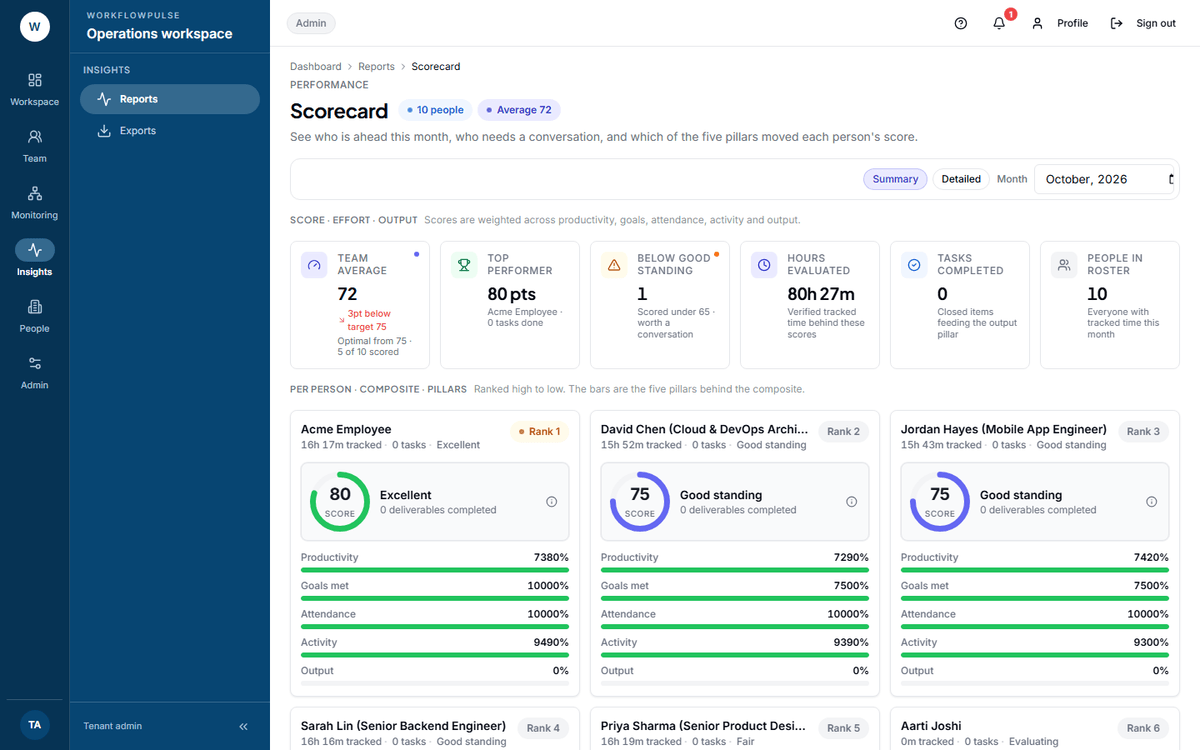 Every card shows the five bars under the dial. That layout is deliberate — the single number tells you to look, the five bars tell you what at.
What question it answers
Section titled “What question it answers”Who is ahead this month, who needs a conversation, and which of the five pillars moved each person’s score.
Where the numbers come from
Section titled “Where the numbers come from”Five parts, each scored and then blended into one number out of 100:
Productivity · Goals met · Attendance · Activity · Output
- Productivity comes from your app rules, so it inherits their quality.
- Goals met comes from the daily goals set on Alerts and goals. No goal set means nothing to meet.
- Attendance and Activity come from tracked time and input.
- Output comes from completed tasks.
The five are the useful part. The single number on the front is a summary of them and nothing more.
The bands
Section titled “The bands”| Score | Band |
|---|---|
| 80 and above | Excellent |
| 65 to 79 | Good standing |
| 50 to 64 | Fair |
| Under 50 | Needs attention |
| No data | Evaluating |
The product treats 75 as the team line. The Team average tile says “Optimal from 75” and reports how many points above or below it you are. Below good standing counts everybody under 65, with the hint “Scored under 65 · worth a conversation”.
A person with no tracked time shows Evaluating and a dash, not a zero. That distinction matters: an absent person is not a failing one.
The two views
Section titled “The two views”Summary — one card per person with a dial, a rank, the band, the count of completed items, and the five bars.
Detailed — a table: Rank, Employee, Score, the five pillars, Tracked, Tasks.
Using it without doing damage
Section titled “Using it without doing damage”This is the report most likely to be misread, so four rules.
A rank on a small team says nothing. Somebody is always fourth out of four, including in a team that is doing well. The rank is a sort order, not a judgement.
Nobody sees their own. There is no personal view. If a score is going to be discussed, the person should hear it from you with the five bars in front of both of you — not learn afterwards that it existed.
What it does NOT include
Section titled “What it does NOT include”No export. No button, and no report type behind it.
No date range — whole calendar months only, so you cannot score a sprint or a release week.
No team filter. “Team average” is a tile, not a control. It is the whole workspace.
Nothing feeds back. A score moves nothing, triggers nothing and notifies nobody. It is a number for a person to read and act on.
No history on the screen. One month at a time. To see a trend you change the month box and remember.
What to do with what it shows
Section titled “What to do with what it shows”Somebody in Needs attention — open the five bars before you open a conversation. Then open their Timeline for a day in that month.
A whole team below 65 — that is a measurement problem or a workload problem, not five performance problems.
A pillar that is zero for everybody — usually Goals met, because no goal has been set. Set one on Alerts and goals or accept that the composite is being dragged down by a pillar nobody configured.
Next: Time and motion · Wellness